Linear Algebra - Vectors and Linear Combinations

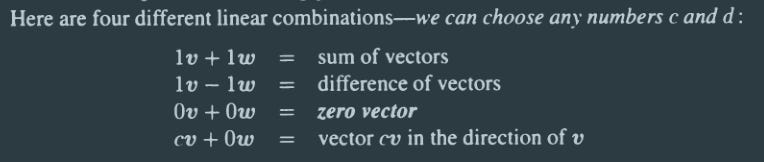
The idea of linear combinations—cv + dw—is at the heart of linear algebra. And that in turn requires two operations: multiplying a vector by a scalar and adding vectors of the same dimensions.
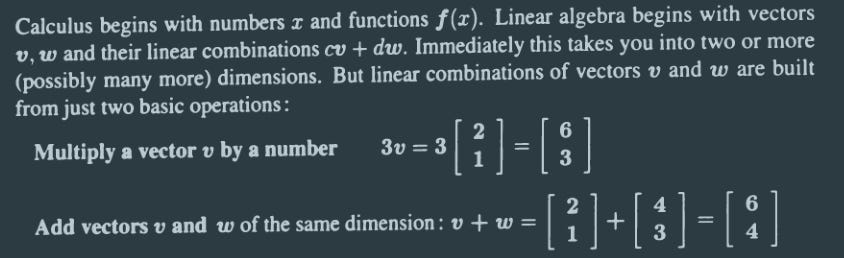
The operations are dead simple to perform, as demonstrated with the example below:

From this, we come up with two key questions:
Plane filling: Say if we list all the variations of a given linear combination—will it fill a line or a plane?
“Reverse-engineer a vector”: Given a vector, split it into the basis vectors, multiply with scalars, and do addition to get the desired result.


The rows of a matrix are also called dimensions—usually denoted by m. And the columns by n.
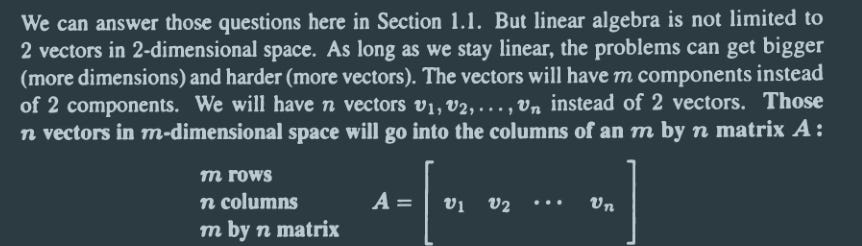
The same two questions mentioned above can be put in matrix notation as follows:

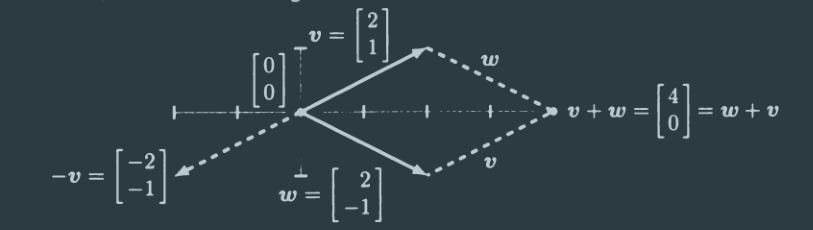
Consider this scenario involving two original vectors, v and w. v^ T is [2, 1]. w^T is [2, -1]. We can “reflect” a vector across the two axes to get -v^T, which is [-2, -1]. To “add” vectors, we must make “copies” of both the vectors and make their ends meet at the same point—geometrically. Algebraically, adding them is straightforward—in a cell-to-cell manner based on their positions. Finally, don’t forget the “zero vector” [0,0]^T, which we see in the image below.
Scaling each of these linearly independent vectors gives us two lines. And linearly combining gives us a plane:

The idea of linear combination automatically brings up or is capable of covering many of the special cases we tend to be familiar with: