
Matrices Are More than Arrays of Numbers

Most matrices contain redundant information.
What is redundant? A column within a matrix could be expressed in terms of some other column. A column that is not linearly independent within a matrix.
So - each linearly independent column specifies a unique “direction.” This “direction” or “frame of reference” is necessary for creating any point within the plane/space in question.
When we extract only the linearly independent components of a given matrix, we get the “essential directions” (column matrix) C.
Then we can merely multiply this base matrix with a coefficient/reconstruction matrix R.
That is:
A = CR
Or - more clearly:
matrix = basis x coordinates
We can compare this to what we do with numbers: factorization. The bigger number can be broken down into primes - or numbers that cannot be broken down.
Matrices also can be broken down into these “columns” or “directions,” the frame upon which the whole edifice of matrices can stand.
How many columns are there? Or how many directions are there? How many “factors” are there - if we are to use the number analogy? This number is called the “rank” of a matrix.
If we are dealing with a plane - then the rank is 2; if a physical space - then the rank is 3. And so on.
It’s essentially the number of unique axes/directions.
Why care about this perspective?
We can reason about the shape of matrices geometrically - if we understand the distinction between directions and instructions/coefficients.
And on top of that intuition - we can prove things, such as impossibility theorems.
It becomes more than a recipe, opening up an opportunity to reason about vectors in dealing with many problems.
An example - consider Matrix A:
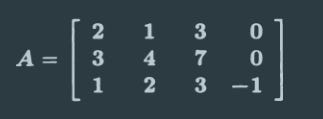
We see that column 3 = column 1 + column 2. So we can factor column 3 out. And then multiply by the coefficient/reconstruction matrix.

So here, the operation on the RHS signifies 12 numbers in the matrix A.
We can take row 1 x col 1, to get cell (1,1).
2*1 + 0*1 + 0*0 = 2
We can take row 1 x col 2 to get (1,2)
2*0 + 1*1 + 0*0 = 1
For each row, we can get 4 sums. We have 3 rows. So 12 sums.
This is how the matrix multiplication works.
The interesting calculation here is on how the following values are generated:
(1,3), (2,3), (3,3)
So it must be result of row 1 x col 3 to get (1,3)
2*1 + 1*1 + 0*0 = 3
We can do row 2 x col 3 to get (2, 3)
3*1 + 4*1 + 0*0 = 7
We can do row 3 x col 3 to get (3,3)
1*1 + 2*1 -1 * 0 = 3
And that produces the column we were expecting of values 3, 7, and 3.
In summary - we can look at matrices as “directions” + “coefficients.” Although we can apply the standard procedures to crunch out numbers - it is important to understand the deeper meaning of the operation to deal with trickier scenarios.