Scale (by Geoffrey West) - Part 23


Along with the science of cities - there is also a relatively new field of the science of risk management. Human society faces risks from many angles and facets, and requires constant vigilance to survive.
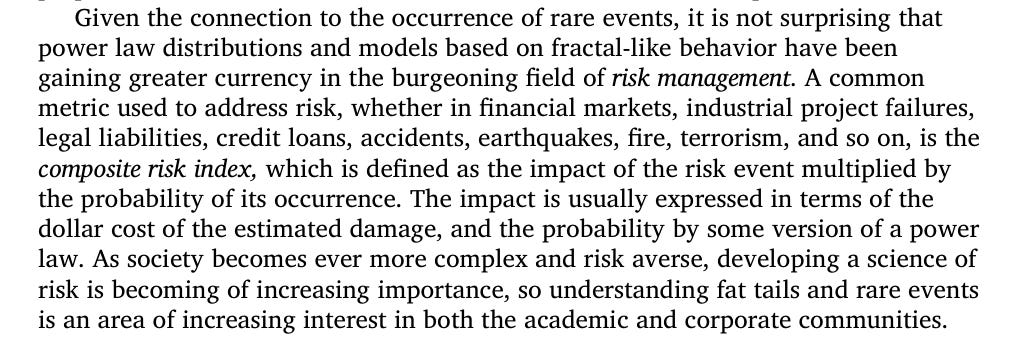
Larger the size of a city, the more opportunities for linking with other people is provided:
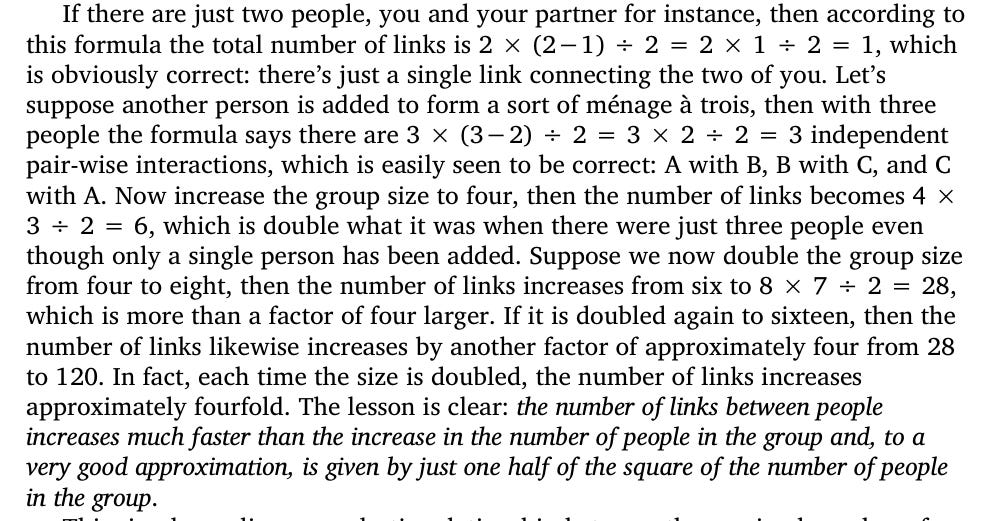
A meeting between more than 6 people is very hard to get going - without suppressing anyone’s views:

The reduction in family size is going to lead to enormous consequences on the individual’s social and psychological profile:
Just a mental exercise - think of the absurd case - where every single person tries to establish at least a small link between every other person in a city:
Lots of socioeconomic quantities are supported by the underlying “link count” within a city; a more collaborative and trusting environment leads to higher productivity and satisfaction:

Regardless of social media - each participant must be seated somewhere physically, and that is a constraint on space:
And to get to places - people must move, use the transport system, which imposes a restriction on their time:
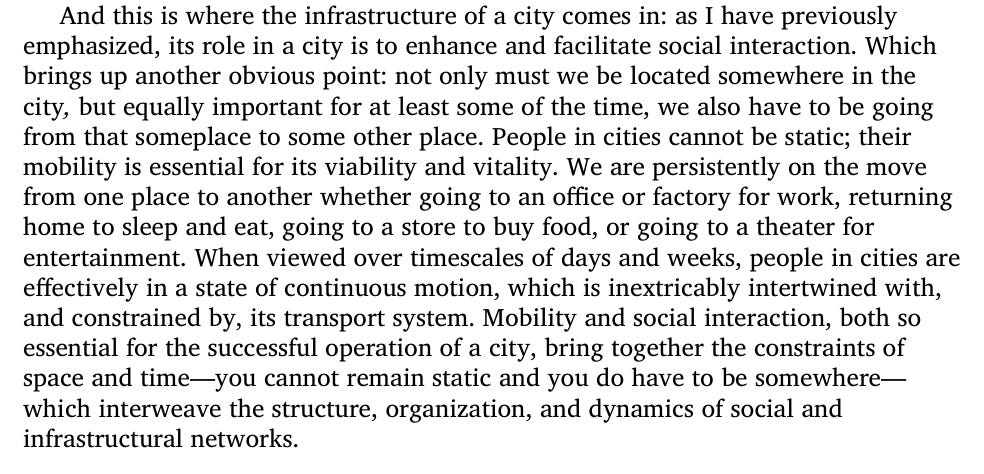
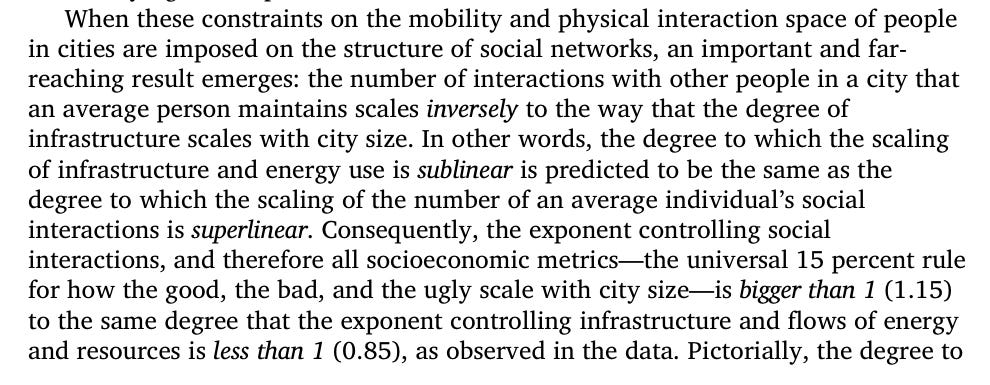
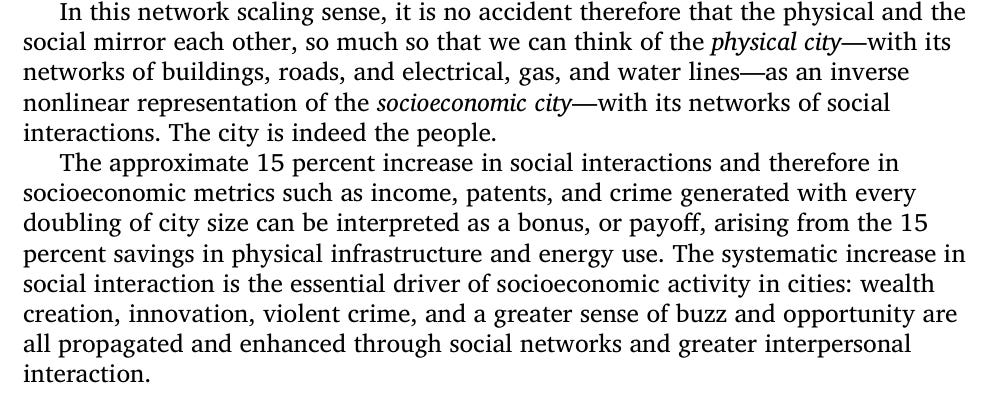
Energy use and infrastructure costs scale sublinearly - whereas the social interactions scale super linearly and this is the central logic for the existence of cities: as they become bigger - many costs go down, whereas the benefits go up:

The author is very focused on the idea that buzz leads to better inventions and so on. I am not thoroughly convinced of it - there are potential counterpoints (Freeman Dyson’s article provided a much better argument of this point).
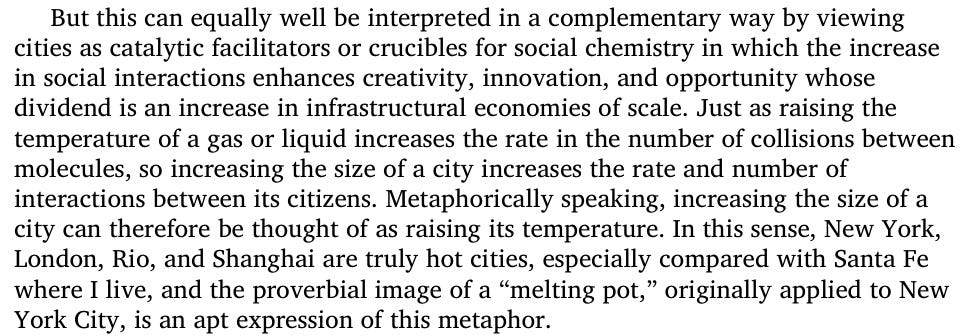
The metaphor of “melting pot” is appropriate for big cities:
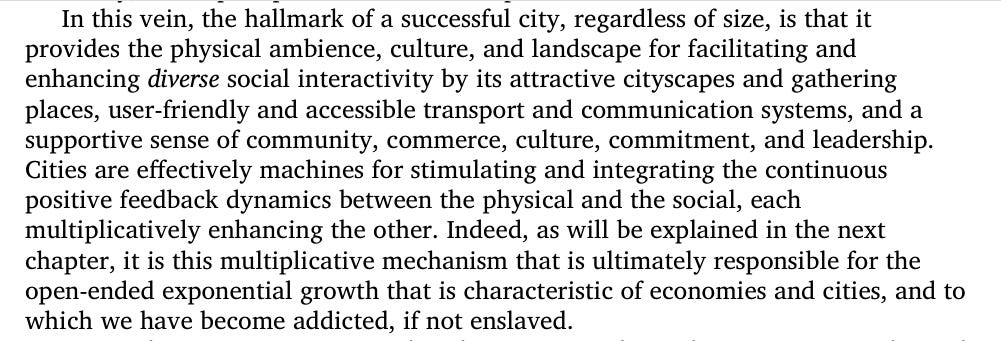
A city is about integrating many things to develop multiplicative effects:
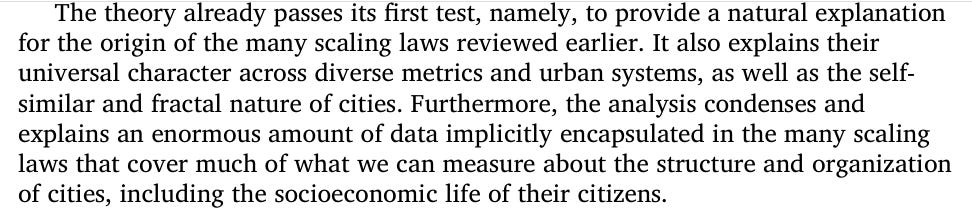
The accomplishments of the theory so far - it is compressing numerous data points into a coherent analytical system:
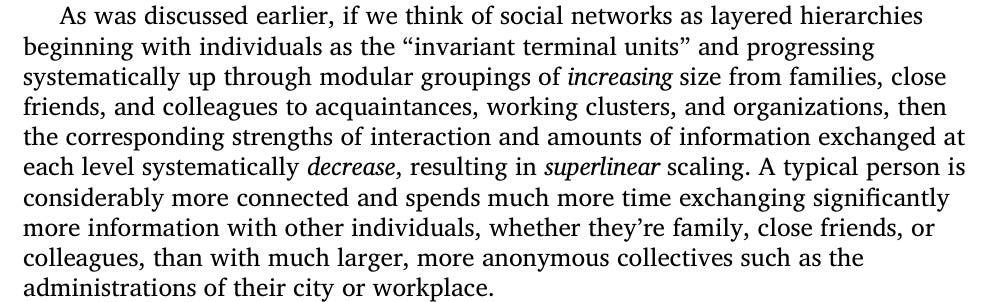
Info exchange is more at the terminal level, and it decreases proportionally as we go higher up in the stack:
The bigger beasts take longer to grow big, stay there for a while, move slow, eat slow, and die slow. This is the way of life wherever there is sublinear scaling. Something to keep in mind:
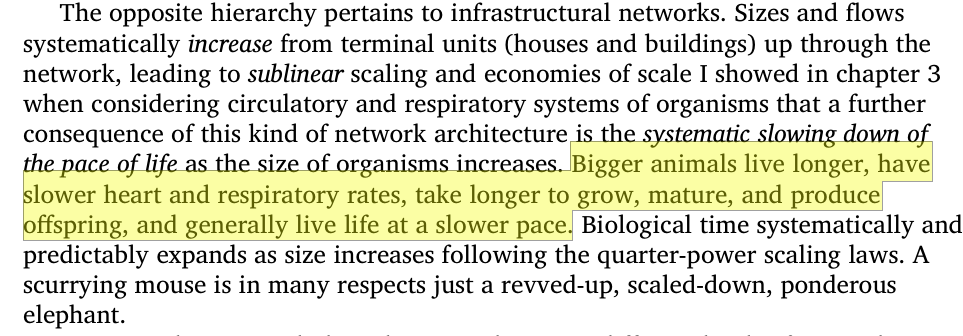
But then there are other networks like social networks - whereas the size increases the pace of life also increases - with superlinear scaling:
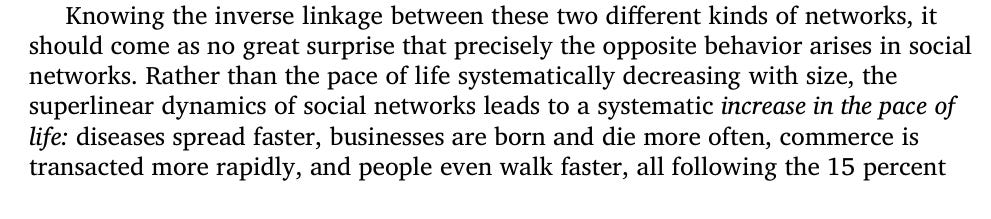

The life of in a city never leaves you alone - there is always one more task to do:

You go back 200 years - intelligent people of the time complain of the same thing - talking about the changes:
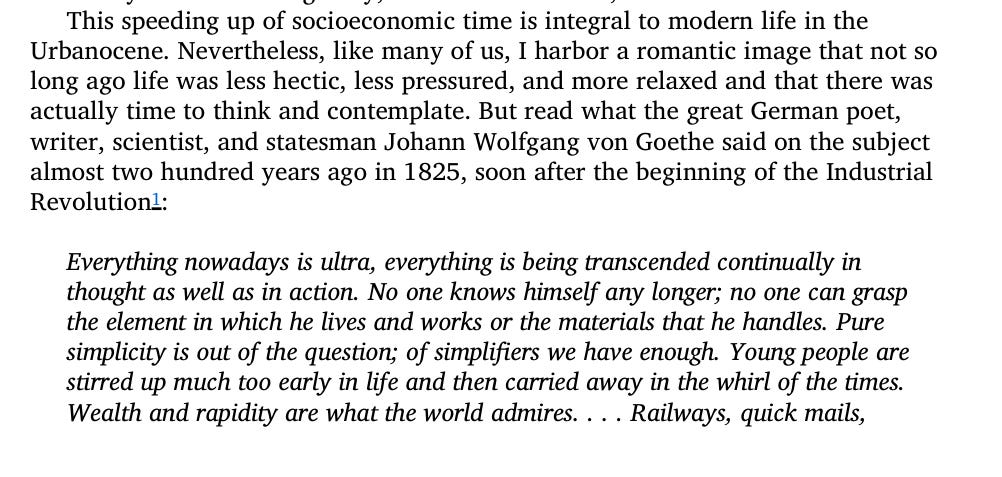

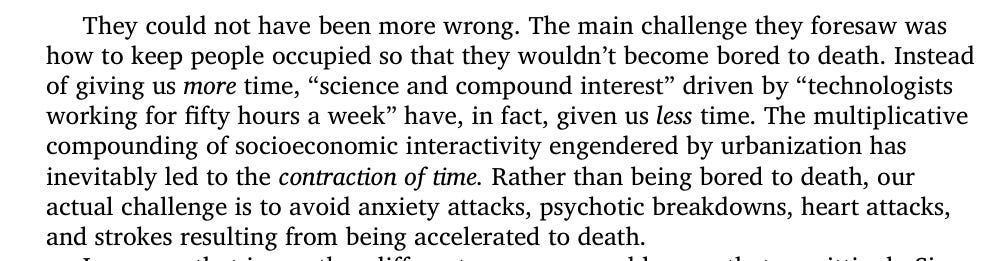
People were to wonder - with all these new inventions - what will we do with the “free time”? But the reality as it has unfolded is - people have less time than ever, are busier than ever and communicating and pushing things forward than ever. This is a big comment on how AI may turn out to be. People may not get “freed up” as we think - we are going to think much, much further, and do insanely difficult things, and occupy ourselves:
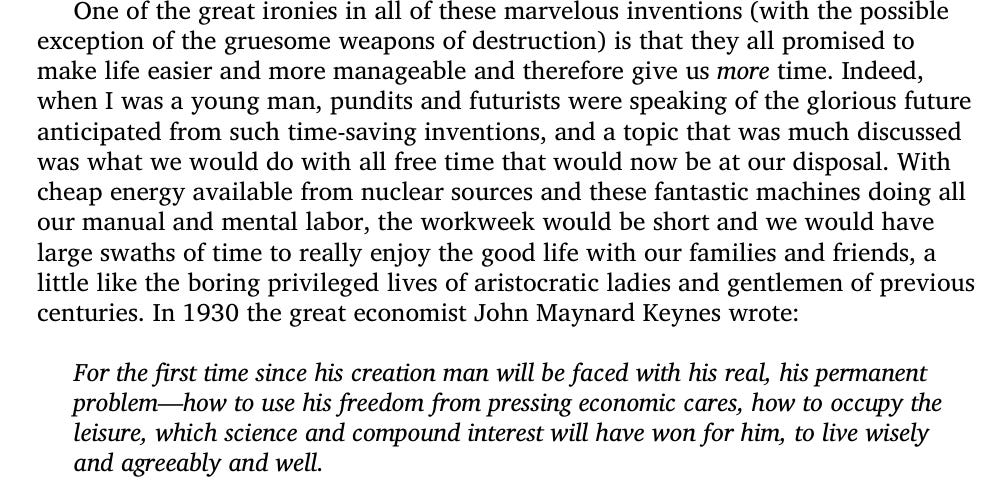
One more specimen of the same argument:
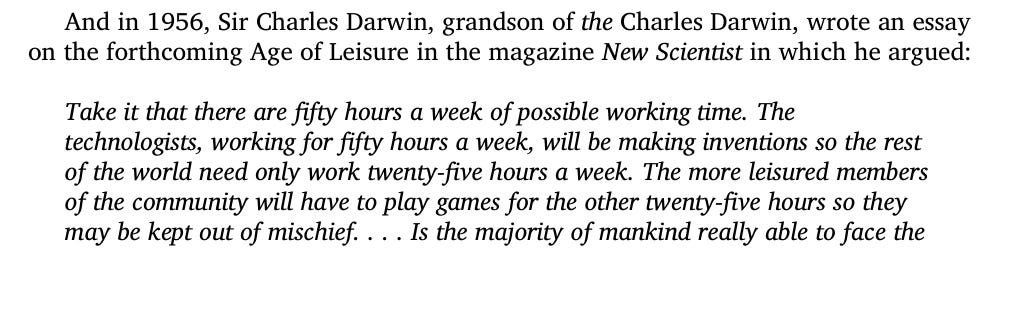

Crazy acceleration is the trend of growing bigger cities and its rapid pace of socioeconomic explosion; the problem is not boredom - but rather coping!
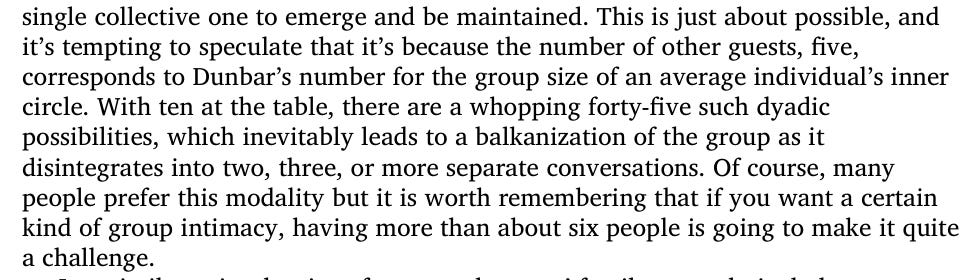
Social media is the new opiate of the people (replacing religion):