
The Dot Product Collapses Vectors to Scalar; the Cross Product Brings a New Direction

The chapter title is “Lengths and Angles from Dot Products.”
Quite simple enough.
We must read it from the opposite direction, though.
We start with “Dot Product”” That has the words “Dot” and “Product””
We know “Product” means multiplication when it comes to numbers.
But what does “Dot” stand for?
The reason William Hamilton picked a “dot” for “dot product” is because a dot is dimensionless, point-like, and has no direction.
So a dot product between two vectors removes the direction and multiple components and produces a simple scalar/number.
Geometrically, it is:
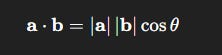
In contrast, the cross product is (x) a new vector, which is perpendicular to both inputs.
The cross product
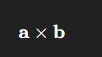
And its magnitude is defined by
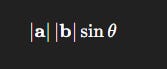
Which refers to the area of parallelogram formed by these vectors
This in turn hints at two directions intersecting, a right angle emerging, and a new orientation.